
#1 SPM 1-to-1 Biology Tutoring Malaysia
SPM Biology Paper 3 practical coaching
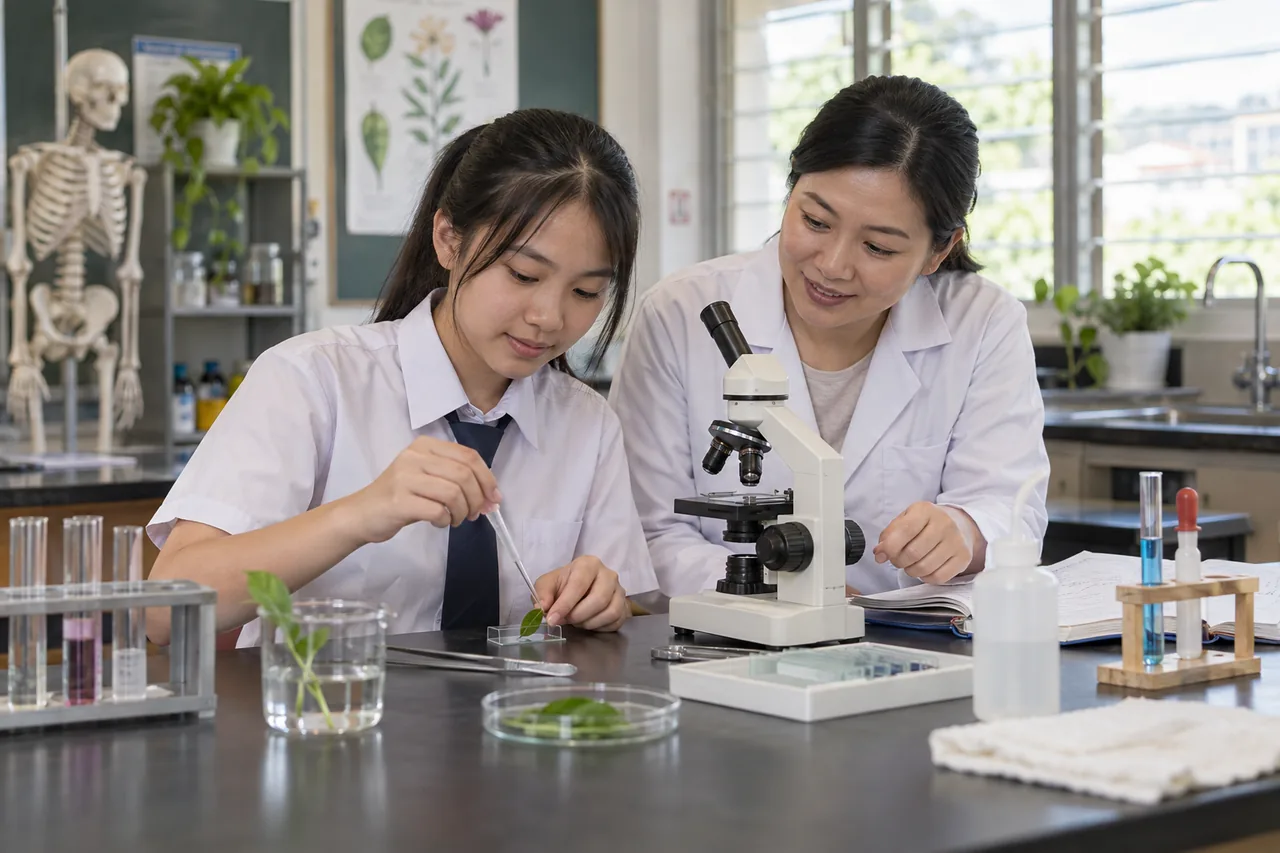
Paper 3 (4551/3) is not about being neat with apparatus, it marks science process skills. Coaching focuses on the parts your child earns marks for: hypotheses, variables, tabulating results, graphs and conclusions.
One-hour paid trial · Same-day reply
Who it's for
- Students who understand Biology but lose marks on the practical paper.
- Candidates who rarely practise Paper 3 skills in a normal class.
- Private candidates with limited lab exposure.
This is right for you if…
- Your child can explain the theory behind an experiment in words, but the marks on the actual Paper 3 script do not reflect that understanding.
- Your child's school covers each DSKP experiment once, briefly, with little time spent writing up a hypothesis or plotting a graph the way the mark scheme expects.
- Your child is a private candidate, or is from a school with limited lab time, and has not had much practice writing up an experiment from scratch.
- You want a teacher to mark actual attempts at hypotheses, tables and conclusions against the mark scheme's exact wording, not just discuss the topic in general.
- Your child struggles specifically with identifying variables, which one is manipulated, which is responding, which are fixed, rather than with the underlying Biology content itself.
- You have limited time before the exam and want to spend it on the one paper where technique, not content, is usually the part being missed.
- Your child needs a plan that spends revision time on Paper 3's specific skills without taking time away from Paper 1 recall or Paper 2 structured practice.
- Your child has a scheduled Paper 3 practical session coming up and wants a dry run of the exact question format beforehand.
What happens in the first hour
- The teacher starts with a DSKP experiment your child's school has already covered, and asks them to state the hypothesis and variables from memory before any correction begins.
- Whatever your child produces is marked against the mark scheme's actual wording, so they see precisely which phrase is missing or vague, not just told it is wrong.
- The teacher rebuilds the hypothesis and variable statements aloud, in the exact form Paper 3 rewards, then has your child restate it unaided to check it has transferred.
- A results table or graph from the same experiment is checked next, since labelling, units and scale are common places marks are lost even when the numbers themselves are correct.
- The hour closes with your child writing one full inference or conclusion from that experiment's data, marked on the spot against what the data actually shows.
- One specific experiment or skill, writing a hypothesis, drawing a graph, or forming a conclusion, is named to continue with next time, so progress compounds lesson to lesson.
- If your child already has a completed but ungraded attempt at an experiment, the teacher marks that first, so the first lesson starts from the actual gap rather than a fresh worksheet.
Paper 3 is a paper skill, not a lab skill
Most students assume Paper 3 depends on lab equipment, so they never practise it, and lose easy marks. In fact the practical assesses science process skills on paper: stating a hypothesis, identifying and controlling variables, recording results in a proper table, drawing a graph and making a valid conclusion.
All of that can be coached one-to-one over video with a shared worksheet. The teacher walks through the DSKP experiments, marks your child’s planning and analysis, and drills the exact phrasing the mark scheme rewards.
A concrete example: a student who can say water moves into a plant cell by osmosis often cannot write "as the sucrose concentration decreases, the mass of the potato chip increases", the exact cause-and-effect phrasing a hypothesis needs. The Biology is understood; the sentence structure the mark scheme is looking for is the actual gap, and it is a gap that direct marking closes quickly.
What a lesson looks like
Lessons work through the practical structure using the DSKP experiments, hypothesis, variables, apparatus, procedure, results and inference, and mark your child’s attempts.
The teacher focuses on the common Paper 3 mistakes: vague hypotheses, uncontrolled variables and conclusions that do not use the data.
Each lesson usually centres on one DSKP experiment from the syllabus rather than a general review of practical skills, so your child leaves with a complete, correctly written attempt at that specific experiment.
Marking happens during the lesson, sentence by sentence where needed, so your child hears exactly which word or phrase the mark scheme is looking for while the attempt is still fresh.
Because science process skills repeat across experiments, the same hypothesis structure, the same variable-naming pattern, a skill drilled once on one experiment is checked again on a different experiment in a later lesson to confirm it has actually transferred.
A short recap of the previous experiment's mark scheme happens at the start of the next lesson, so mistakes from last time are checked before moving to a new experiment, rather than repeated with the same wording.
What we cover
The science process skills the Paper 3 format assesses, applied to the compulsory DSKP experiments across the syllabus.
How to present tables and graphs, and how to write a conclusion that earns full marks.
Drawing and interpreting graphs, choosing the correct axes, plotting points accurately, and reading a value off a curve, which Paper 3 tests directly and which a normal science lesson often has little time to drill.
The exact command words Paper 3 uses, state, identify, tabulate, infer, and what a full-marks answer to each looks like, since losing marks on a command word is common even when the underlying science is understood.
Practical vocabulary specific to Paper 3, terms like 'constant', 'accuracy' and 'control experiment', used the way the mark scheme expects, rather than in the looser sense the same words carry in everyday English.
A short list of experiments already covered and marked is kept from lesson to lesson, so nothing needs to be re-explained from memory alone.
The Paper 3 skills we coach
Paper 3 assesses these science process skills, applied to the DSKP experiments:
- Observing
- Classifying
- Measuring and Using Numbers
- Making Inferences
- Predicting
- Communicating
- Using Space-Time Relationships
- Interpreting Data
- Defining Operationally
- Controlling Variables
- Making Hypotheses
- Experimenting
One-hour paid trial · Same-day reply
Who teaches
Every lesson is taught by one of our experienced Biology teachers, chosen for your child and held to our published teaching standard.
Rate & trial
Lessons are from RM50/hr. The exact rate depends on the teacher's experience and is confirmed on WhatsApp. The trial is a paid one-hour lesson at the teacher's rate, a real lesson with real marking, so you can judge the teaching before you continue.
Simple and flexible
- Lessons are one-to-one and delivered in English.
- Book lessons as your child needs them, weekly, fortnightly, or intensively before an exam.
- Pay per hour, with a paid trial first and each lesson booked as you go.
Practising Paper 3 skills between lessons
Rewriting a hypothesis for an experiment your child has already studied in school, without looking at the textbook version, is a fast way to check whether the structure, "as [manipulated variable] increases/decreases, [responding variable] increases/decreases", has actually been learned.
Redrawing a graph from an old set of results, from memory of the correct axes and scale, tends to expose gaps that a completed graph already on the page can hide.
Naming the three types of variable, manipulated, responding, fixed, out loud for any experiment mentioned in class, even one not being tested that week, keeps the habit sharp across the whole syllabus rather than only the topic just covered.
A short weekly habit of writing one full conclusion from a set of results, in the "as… because…" form Paper 3 rewards, builds the exact skill tested on exam day faster than reading model answers alone.
Reviewing an experiment a few days after first covering it, rather than only right before a test, checks whether the hypothesis and variables have moved into longer-term memory rather than short-term recall from the lesson itself.
Working through the DSKP experiment list once, chapter by chapter, and marking which ones already feel solid, turns an open-ended "revise Paper 3" task into a short, specific list of experiments still needing practice.
One-to-one vs the usual alternative
| Paper 3 coaching | Ignoring Paper 3 | |
|---|---|---|
| Skills | Drilled and marked | Untested until the exam |
| Marks | Earned on planning & analysis | Left on the table |
| Lab access | Not needed, done on paper | Assumed necessary |
Where we serve, online across Malaysia
DungunTumpatBeaufortSri AmanKlangSungai BulohPort KlangSri PetalingNibong TebalYanTaipingSungai Siput
This service by town
Frequently asked questions
Can Paper 3 be taught online without a lab?
What does Paper 3 actually test?
My child understands Biology but fails Paper 3, why?
Which DSKP experiments does coaching cover?
How is Paper 3 coaching different from a normal Biology lesson?
Can Paper 3 coaching be combined with regular content lessons?
How many lessons does Paper 3 coaching usually take?
Source:SRC-DSKP-EN, SRC-FORMAT
One-hour paid trial · Same-day reply