
#1 SPM 1-to-1 Biology Tutoring Malaysia
SPM Biology tuition, one-to-one and online
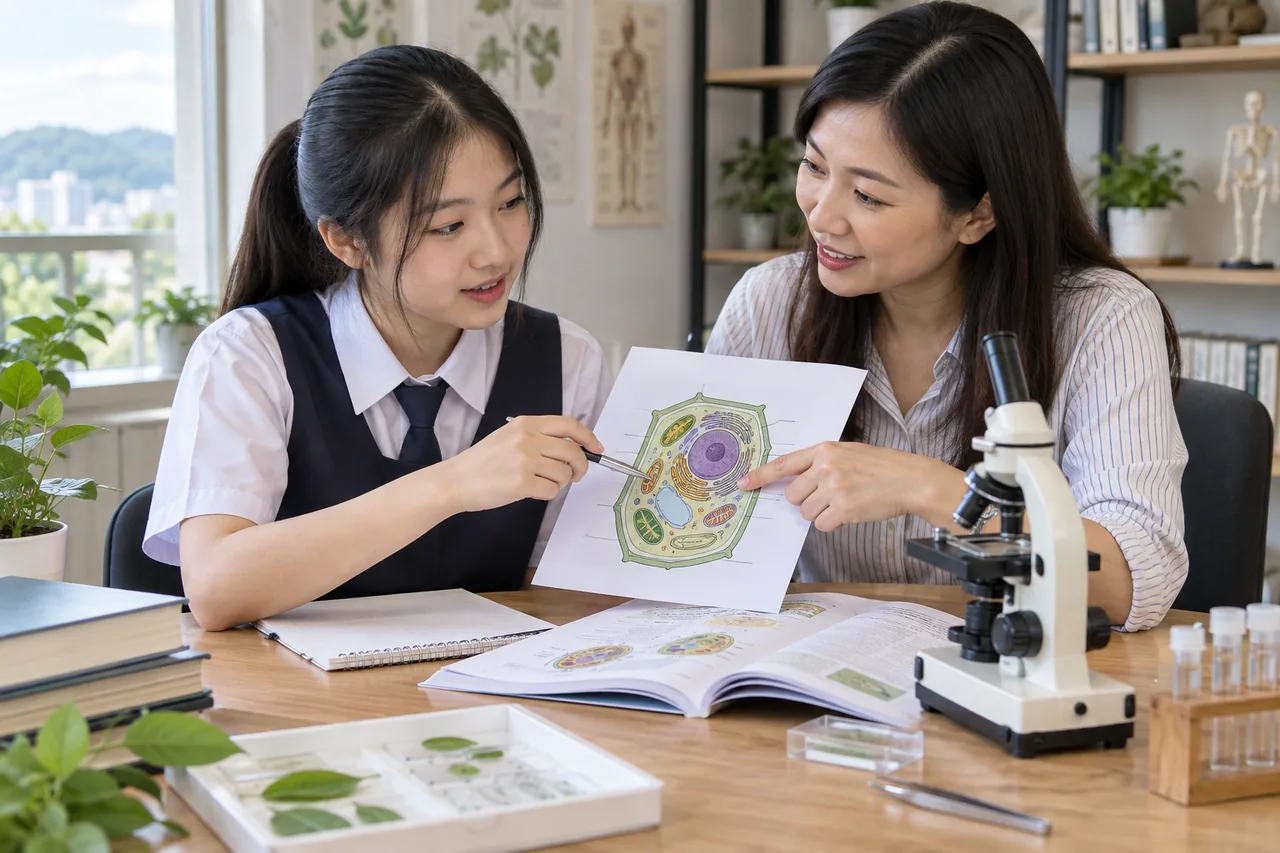
Your child is taught one-to-one over video by one of our experienced Biology teachers, built around the KSSM syllabus (code 4551), its 28 chapters, three papers, and the exact terminology the exam rewards.
One-hour paid trial · Same-day reply
Who it's for
- Form 4 or Form 5 students taking SPM Biology (4551).
- Students who understand Biology in class but lose marks on precise definitions and Paper 2 essays.
- Students rebuilding a weak foundation before the syllabus moves on.
- Repeat and private candidates re-sitting the paper.
- Parents who want their child taught the current syllabus, not last year's.
This is right for you if…
- Your child is in Form 4 or Form 5, taking SPM Biology (4551), and needs steady support across the syllabus rather than a one-off fix.
- Marks are slipping on precise definitions, diagram labels or Paper 2 structure, not on effort or interest in the subject.
- A group class moves at a pace that leaves your child either bored or lost, with little time left over for their specific questions.
- You want a teacher who can start from wherever your child actually is, behind, on track, or polishing for a top grade, rather than a fixed course everyone follows the same way.
- Your family wants a teacher who reports honestly on progress, including when a topic still needs more time, rather than one who tells you what is easiest to hear.
- You are willing to try one paid lesson first and judge the teaching yourself before committing to anything longer.
What happens in the first hour
- The lesson opens with a short conversation and a few quick questions, so the teacher can see what your child already knows before deciding what to teach next.
- If a content gap shows up, the teacher explains it once, checks that your child can explain it back in their own words, then moves to practice, Biology is remembered by using it, not by hearing it twice.
- Diagrams are drawn or labelled live and checked against the exact terms the exam expects, since a correct idea with the wrong label still loses the mark.
- Where the content is already solid, the lesson shifts to an exam-style question, answered under mild time pressure and then marked line by line against the keywords a marker looks for.
- By the end of the hour you will have a clear, specific sense of what your child can already do well and what still needs work, not just a general impression.
- The lesson ends with one or two specific things to practise before the next lesson, never a vague instruction to 'revise the chapter', always the exact gap the hour uncovered.
Why Biology rewards one-to-one
Biology is the SPM science with the most to remember and the least room for guessing. Marks are won on exact wording, the right term, the right order of a process, the correctly labelled diagram, and lost on 'close enough'.
A group class can explain a topic well, but it cannot sit with your child while they try to recall it and catch the small errors that quietly cost marks.
One-to-one changes what a lesson can do. The teacher runs active recall until your child produces the answer without prompting, labels diagrams until the labels are automatic, and marks Paper 2 essays against the keyword scheme until structure becomes a habit.
That loop, recall, check, correct, is the part most students never get enough of, and it is exactly what a private hour is for.
What a lesson looks like
A lesson is one-to-one, one teacher and one student, no class to hide in and no pace set by anyone else. The teacher starts from what your child can and cannot yet do, then works on that.
Biology is recall-heavy, so lessons mix three things: understanding the concept, drilling the recall of terms and diagrams, and practising exam answers. A typical lesson might explain a process, label the diagram until it is automatic, then work an original Paper 2 question and mark it against the keywords the examiner looks for.
Everything is online, so a student in any part of Malaysia can be taught by the right teacher, and lessons fit around school and boarding schedules.
Lessons are logged, so a teacher who has not seen your child in a fortnight can pick up exactly where the last one left off, which topic was covered, which questions were still shaky, and what was set for practice. Nothing has to be re-explained from scratch just because time has passed between sessions.
How often lessons happen is left to your family, not a fixed schedule. Some students take one lesson a week through the year; others book only around a specific exam or a topic that has gone wrong in class.
Because each lesson is booked one at a time, the frequency can change as the syllabus, the school calendar, or your child's confidence changes.
Because each child has their own teacher rather than a place in a class, a student who does not click with the first teacher can simply move to another, there is no class placement to unwind, and no term fee to lose in the process.
What we cover
We cover the full KSSM Biology syllabus: 15 chapters in Form 4 and 13 chapters in Form 5, 113 content standards in total. Lessons can focus on a single chapter your child is stuck on, or run a structured path through both forms.
We prepare for all three papers as the LP format sets them: Paper 1 (40 objective questions, 1 hour 15 minutes), Paper 2 (100 marks across Sections A, B and C in 2 hours 30 minutes), and Paper 3, the practical, which tests science process skills. We coach recall for Paper 1, essay structure for Paper 2, and planning and variables for Paper 3.
Lessons are not run the same way for every topic. A definition-heavy chapter such as nutrition or coordination is drilled through recall and labelling; a process-heavy chapter such as photosynthesis or respiration is walked through step by step until the sequence is automatic; and a numeracy topic such as genetics is worked through with Punnett grids and ratios until the method holds up under time pressure.
Where a student is preparing for a specific paper rather than a specific chapter, a lesson can focus entirely on that paper's demands, elimination strategy and careful reading for Paper 1, structured-answer and essay planning for Paper 2, or variables, tabulation and inference for the Paper 3 practical.
The full syllabus we cover
Lessons cover the complete KSSM Biology syllabus, organised into five themes:
Fundamentals of Biology
Physiology of Humans and Animals
- Form 4 · Respiratory System in Humans and Animals
- Form 4 · Nutrition and Human Digestive System
- Form 4 · Transport in Humans and Animals
- Form 4 · Immunity in Humans
- Form 4 · Coordination and Response in Humans
- Form 4 · Homeostasis and Human Urinary System
- Form 4 · Support and Movement in Humans and Animals
- Form 4 · Sexual Reproduction, Development and Growth in Humans and Animals
Physiology of Flowering Plants
Ecosystem and Environmental Sustainability
Inheritance and Genetic Technology
One-hour paid trial · Same-day reply
Who teaches
Every lesson is taught by one of our experienced Biology teachers, chosen for your child and held to our published teaching standard.
Rate & trial
Lessons are from RM50/hr. The exact rate depends on the teacher's experience and is confirmed on WhatsApp. The trial is a paid one-hour lesson at the teacher's rate, a real lesson with real marking, so you can judge the teaching before you continue.
Simple and flexible
- Lessons are one-to-one and delivered in English.
- Book lessons as your child needs them, weekly, fortnightly, or intensively before an exam.
- Pay per hour, with a paid trial first and each lesson booked as you go.
How to make lesson time count between sessions
Revision between lessons works best when it rehearses recall rather than rereading. Closing the notes and writing out a process from memory, then checking it against the notes afterwards, shows exactly what still needs work, rereading a page that already looks familiar rarely does.
Keep a single running list of terms and diagrams that came up wrong in a lesson or a test, organised by chapter. A short list reviewed often does more good before an exam than a full set of notes read once.
For Paper 2, redrafting one essay-style answer against the keywords a marking scheme rewards is more useful than writing three new answers without checking any of them, because the correction is where the learning actually happens.
Doing a handful of past-style objective questions under a timer, even five minutes' worth between lessons, keeps the recall speed Paper 1 needs from fading over a school term.
Bring the specific question or answer your child got wrong to the next lesson rather than a general sense that a chapter 'did not make sense', a teacher can fix a precise gap in minutes but needs the actual example to see where the reasoning went wrong.
One-to-one vs the usual alternative
| One-to-one with us | A typical group class | |
|---|---|---|
| Attention | The whole lesson is your child's | Shared between 8-30 students |
| Pace | Set by your child's gaps | Set by the class average |
| Recall practice | Drilled live, corrected on the spot | Usually left as homework |
| Paper 2 essays | Written and marked with you | Rarely marked individually |
| Commitment | Book as needed; paid trial first | Term packages, paid upfront |
Where we serve, online across Malaysia
SandakanKuchingMukahRawangSeri Kembangan (Serdang)Wangsa MajuGeorge TownKulimArauKamparSkudaiTangkak
This service by town
Frequently asked questions
How does the trial work?
What does SPM Biology tuition cost?
Are lessons in English or Malay?
Can we choose specific chapters?
How often should lessons happen?
What if my child is behind in more than one chapter?
Do lessons prepare for Paper 3, the practical test?
Can lessons be arranged around exam dates or school holidays?
Source:SRC-DSKP-EN, SRC-FORMAT
One-hour paid trial · Same-day reply