
#1 SPM 1-to-1 Biology Tutoring Malaysia
One-to-one SPM Biology class
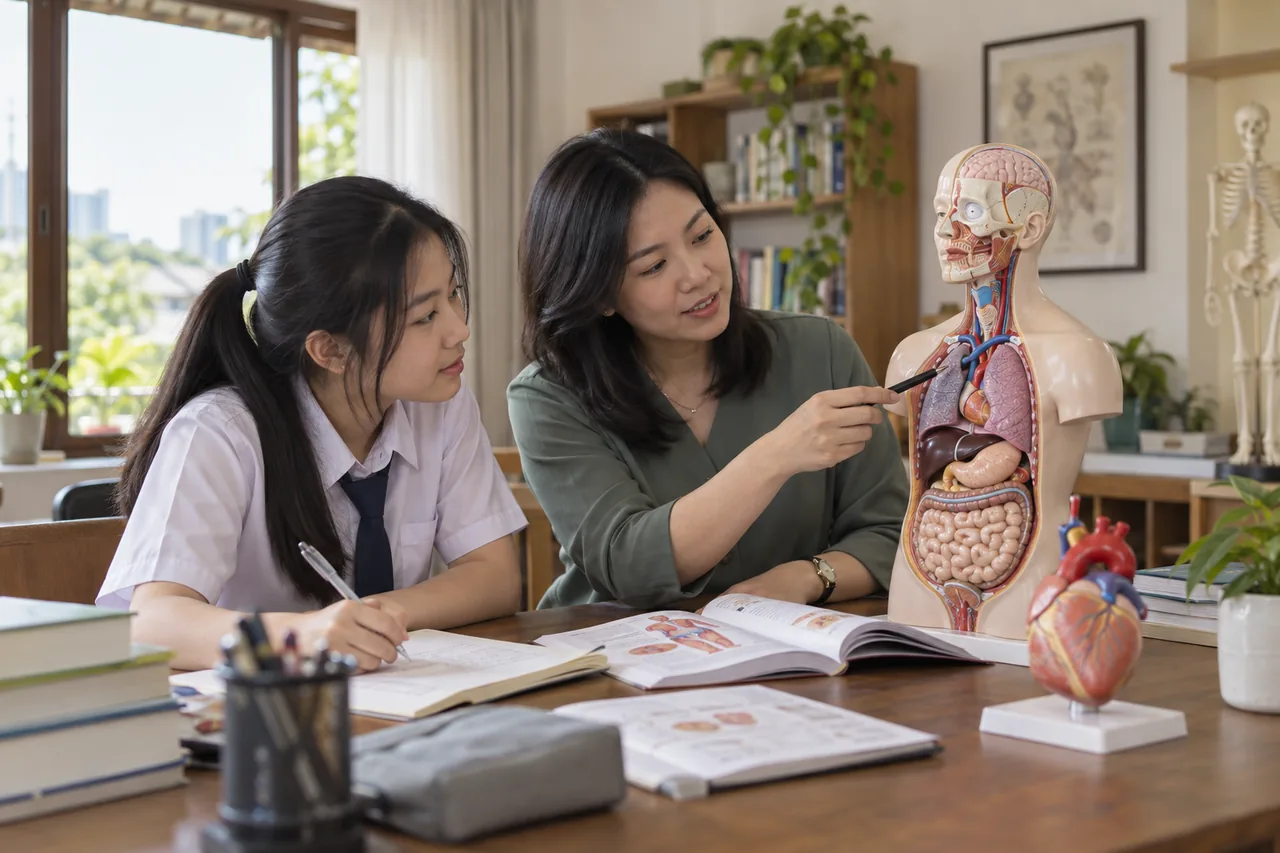
A one-to-one class is one teacher and one student, spent entirely on what your child has not yet mastered in the KSSM syllabus (4551), not on a pace set by twenty other students.
One-hour paid trial · Same-day reply
Who it's for
- Students who stay quiet in a group and never get their specific question answered.
- Students far ahead or far behind the class, held back or lost by the average pace.
- Students who need a chapter re-taught properly, not just re-mentioned.
- Anyone whose marks are stuck despite attending group tuition already.
- Parents deciding between a one-to-one class and a group class for the first time, not switching from one to the other.
This is right for you if…
- Your child's marks have stopped improving despite regular attendance at a group class.
- A specific misunderstanding, a wrong definition, a mixed-up mechanism, keeps reappearing in test after test.
- Your child is either bored waiting for the rest of the class to catch up, or lost trying to keep up with it.
- You want every minute of the hour spent on your child, with nothing shared with other students.
- You are willing to pay a per-hour rate for a class that adapts fully to one student, rather than a lower per-student rate for a shared pace.
What happens in the first hour
- The teacher starts by asking your child to explain, in their own words, a definition or process from the chapter in question, this alone often reveals the exact gap.
- Rather than a set lecture, the hour follows what your child gets wrong: a shaky answer is stopped, corrected and re-asked immediately, not noted for later.
- Your child answers a short exam-style question partway through the hour, which the teacher marks on the spot using the same keywords an examiner would look for.
- If the first answer reveals a second, unrelated gap, the teacher decides with you whether to address it now or in the next lesson, rather than trying to fix both in one rushed hour.
- The lesson ends with your child able to state clearly what they now understand that they did not an hour ago, and what to practise before the next lesson.
What one-to-one gives that a group cannot
In a group, a teacher explains to the middle of the room and moves on. Your child either kept up or did not, and there is rarely time to find out which.
In a one-to-one class the teacher watches your child think, sees the exact moment a definition goes wrong, and fixes it before it becomes a habit.
That difference matters most in Biology, where marks turn on precise recall. The teacher can ask your child to explain osmosis, hear the missing word, and drill it until it is right, something no group class has the minutes to do for every student.
This also changes how mistakes are handled. In a group, correcting one student's wrong answer in front of the class can be uncomfortable enough that the student stops volunteering answers at all.
In a one-to-one class, the same correction happens privately and immediately, so it gets fixed rather than avoided.
None of this means a group class has no value, it can be efficient for a first pass through new content. The difference matters most for the specific chapters or paper skills where your child has already had that first pass and is still stuck.
As one-to-one classes continue, a pattern often becomes visible that a single group lesson would never reveal, the same type of mistake reappearing in unrelated chapters, such as mixing up a structure with its function, or losing marks for stating a mechanism without the linking word an examiner is trained to look for. Once a teacher sees that pattern, later classes can address it directly instead of treating each wrong answer as a one-off.
What a lesson looks like
Every class is one teacher and your child, over video. It starts with what went wrong last time or what is due next, then works on exactly that: understand, recall, apply.
There is no audience, so a student who is embarrassed to ask in class asks freely here. The teacher marks answers on the spot and sends your child away knowing precisely what to practise.
If a chapter needs re-teaching from scratch rather than just clarifying, the hour can be spent that way, there is no fixed curriculum pace to keep up with, unlike a group class working through a term plan.
Homework, when set, is specific to what came up in that hour: a named set of questions on the exact misunderstanding found, not a general worksheet handed to the whole group.
What we cover
Any part of the KSSM syllabus, 15 chapters in Form 4, 13 chapters in Form 5, at your child's pace. A single class can rescue one hard chapter or build a steady path through both years.
All three papers: recall for Paper 1 (40 objective questions), essay structure for Paper 2 (100 marks), and science process skills for the Paper 3 practical.
A one-to-one class also works well for a single stubborn topic rather than an ongoing weekly arrangement, one hour on genetics ratios, for instance, without committing to a term of lessons on everything else.
For a student ahead of their group class, the hour can move faster than the syllabus pace, using past-year questions and Paper 2 essay practice instead of content their group has not covered but they are ready for.
Because a class is not tied to one syllabus year, it can also carry a student across the move from Form 4 to Form 5 content, revisiting a Form 4 foundation topic in the same hour as a new Form 5 concept that depends on it, rather than treating the two years as separate blocks.
The full syllabus we cover
Lessons cover the complete KSSM Biology syllabus, organised into five themes:
Fundamentals of Biology
Physiology of Humans and Animals
- Form 4 · Respiratory System in Humans and Animals
- Form 4 · Nutrition and Human Digestive System
- Form 4 · Transport in Humans and Animals
- Form 4 · Immunity in Humans
- Form 4 · Coordination and Response in Humans
- Form 4 · Homeostasis and Human Urinary System
- Form 4 · Support and Movement in Humans and Animals
- Form 4 · Sexual Reproduction, Development and Growth in Humans and Animals
Physiology of Flowering Plants
Ecosystem and Environmental Sustainability
Inheritance and Genetic Technology
One-hour paid trial · Same-day reply
Who teaches
Every lesson is taught by one of our experienced Biology teachers, chosen for your child and held to our published teaching standard.
Rate & trial
Lessons are from RM50/hr. The exact rate depends on the teacher's experience and is confirmed on WhatsApp. The trial is a paid one-hour lesson at the teacher's rate, a real lesson with real marking, so you can judge the teaching before you continue.
Simple and flexible
- Lessons are one-to-one and delivered in English.
- Book lessons as your child needs them, weekly, fortnightly, or intensively before an exam.
- Pay per hour, with a paid trial first and each lesson booked as you go.
How to make the next one-to-one class more useful
Because a one-to-one class follows what your child actually gets wrong, coming to it with one specific question, a definition that keeps failing, a diagram that will not label correctly, uses the hour more efficiently than a general 'please cover this chapter'.
Keeping the marked answer from the previous lesson and glancing over it before the next one helps the teacher pick up exactly where the last correction left off, rather than re-explaining the same point from the beginning.
Between classes, practice works best when it targets the exact gap named at the end of the last lesson, the same set of questions attempted again, or a similar question from a different chapter, rather than open-ended revision of the whole topic.
None of this is compulsory. A class that starts with 'I'm not sure what's wrong, just that my marks are stuck' still works, the teacher's first questions in the hour are designed to find the gap either way.
Bringing a labelled diagram your child has already attempted, even one with a few wrong labels, gives the teacher something concrete to correct against, rather than starting from a blank diagram. The same applies to a Paper 3 practical write-up: a partly completed answer shows exactly which step broke down.
One-to-one vs the usual alternative
| One-to-one class | Group class | |
|---|---|---|
| Questions | Answered the moment they arise | Often not asked at all |
| Pace | Your child's | The class average |
| Marking | On the spot, every answer | Rarely individual |
| Shy students | Ask freely, no audience | Stay quiet |
Where we serve, online across Malaysia
Simpang RenggamBahauCameron HighlandsBesutKota KinabaluRanauKapitPuchongBantingKepongSegambutAlor Setar
This service by town
Frequently asked questions
My child already attends group tuition, why switch?
Is one-to-one more expensive?
Can we do one class a week?
Can we try one-to-one for just one chapter, not the whole subject?
How does the teacher know what to focus on without knowing my child beforehand?
Is one-to-one better for a student who is already scoring well?
What happens if my child cannot explain why an answer is wrong?
Do we need to choose between one-to-one and group tuition permanently?
Can a one-to-one class help with the Paper 3 practical, not just written recall?
How is a one-to-one class different from a recorded video lesson or an app?
How long is a one-to-one class?
Source:SRC-DSKP-EN, SRC-FORMAT
One-hour paid trial · Same-day reply