
#1 SPM 1-to-1 Biology Tutoring Malaysia
Online SPM Biology tutor for Form 4 & 5
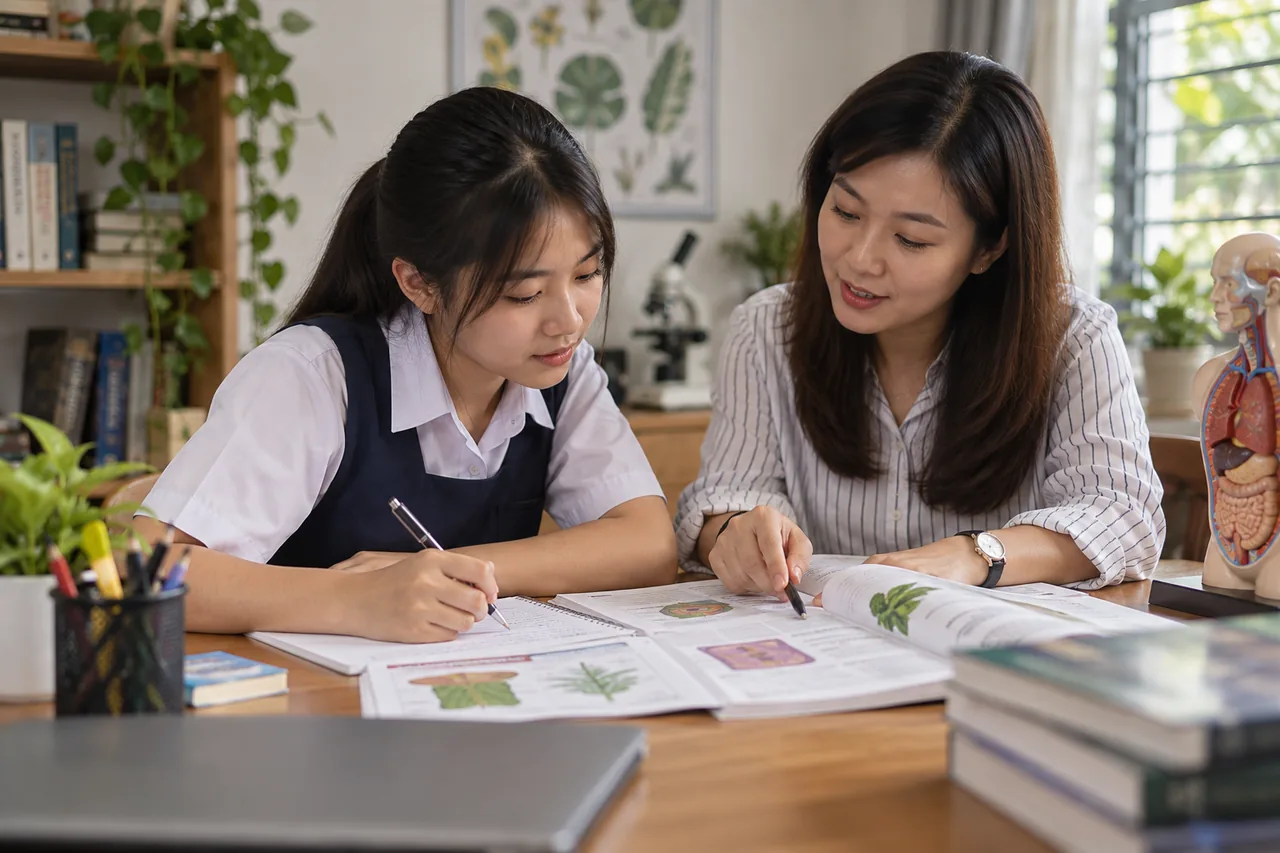
An online SPM Biology tutor means your child is taught by the right teacher regardless of where you live, over video, one-to-one, around the KSSM syllabus (4551) and its 28 chapters.
One-hour paid trial · Same-day reply
Who it's for
- Families outside the big-city tuition centres who want an experienced Biology teacher.
- Students whose schedule (boarding, distance, activities) makes travelling to a centre hard.
- Students who focus better in their own room than in a busy class.
- Parents who want to see and hear the lesson happening at home.
This is right for you if…
- Your child already has a laptop or tablet with a camera and a reasonably quiet corner at home, and travelling to a centre would take longer than the lesson itself.
- You have looked for an experienced Biology teacher nearby and found the choice limited to whoever happens to teach at the closest centre, not the teacher best suited to your child.
- Your child concentrates better alone at a desk than in a room with other students, and has said as much about group classes before.
- You want to watch a lesson happen, sit in on the video call, rather than judge it only from a report card weeks later.
- Your family's week (school hours, other tuition, travel time, sport or co-curricular commitments) makes a fixed weekly trip to a centre difficult to sustain across a full school year.
- Your child is already comfortable typing, writing on a tablet, or holding a notebook up to a camera, and does not need a teacher physically at the same table to follow a diagram.
- Your child has tried a nearby centre before and found the lesson pace set by the group, not by where they personally were stuck.
What happens in the first hour
- The teacher opens the video call and asks your child to share their screen or hold up recent notes, so the actual gap shows itself instead of being guessed from a report card.
- A diagram or process is drawn and labelled live on a shared screen, with the teacher talking through each part as it goes down, not sent afterwards as a finished picture.
- Your child attempts a short written answer on their own paper or device, then shows it to the camera or shares the file, and the teacher marks it in that same minute.
- If the video call or the shared-screen tool is unfamiliar, the first few minutes go into confirming both sides can see and hear clearly, since a smooth setup matters most in that first lesson.
- The teacher names one specific chapter, paper skill or diagram to continue with next time, so the lesson ends with a plan rather than a general instruction to keep revising.
- A parent watching the first lesson can see exactly how the teacher explains a concept, corrects a wrong answer, and paces the hour, before deciding whether to book a second one.
- Homework, if any, is agreed at the end of the hour as one specific, short task rather than a general instruction to revise the whole chapter.
Does online work for Biology?
For Biology, yes, and often better than a centre. The subject is taught through explanation, diagrams and worked answers, all of which share cleanly on a screen.
The teacher annotates a diagram live, pulls up a past-style question, and marks your child's answer in real time. Nothing about that needs a physical room.
The one thing online cannot replace is hands-on Paper 3 apparatus. We handle that by teaching the practical as the exam actually tests it: the science process skills, hypotheses, variables, tabulating results and drawing conclusions, which are marks your child earns on paper, not at a bench.
For those, a screen and a shared worksheet are all it takes.
A concrete example: a student stuck on labelling the human breathing system does not need a physical lung model in the room, a shared diagram on screen, redrawn a few times with the teacher watching each attempt, gets the same labels into memory. What matters for the exam is the label and the function next to it, not the material the diagram was drawn on.
What a lesson looks like
Lessons run over a standard video call your child already knows how to use. The teacher shares their screen to work through diagrams, notes and questions, and your child can share theirs to show their working.
Because it is one-to-one, the teacher adapts the hour live, slowing down on a chapter that is not sticking, speeding through what is already solid. A parent can sit in for the first lesson to see exactly how it runs.
A typical hour moves through three parts: a few minutes checking what your child already knows, the bulk of the time on the actual gap using a diagram or a worked question, and a short written attempt marked on the spot, so the hour stays focused rather than turning into a long lecture.
Notes, labelled diagrams and worked answers from the lesson are usually saved as photos or a shared document afterwards, so revision later does not depend on remembering what was said out loud.
If a call drops or a connection is slow, the lesson picks up from where it stopped rather than restarting from the beginning, and time lost to a technical issue is made up at the end where the teacher's schedule allows.
Because the whole lesson happens on shared documents, screenshots and marked work rather than a physical exercise book, a parent who missed the live lesson can still see exactly what was taught and how it was marked, without needing to ask the teacher for a separate report.
What we cover
The full KSSM syllabus is on the table: 15 chapters in Form 4 and 13 chapters in Form 5. Online lessons make it easy to jump to whichever chapter your child needs this week.
All three papers are prepared as LP sets them, Paper 1 (40 objective questions), Paper 2 (100 marks) and Paper 3, the practical. Recall drills, essay marking and Paper 3 science process skills all work over video.
Diagram-heavy topics, cell structure, the human breathing system, the nephron, the nervous system, get labelled and redrawn live on a shared screen until your child can reproduce them without looking at a reference.
Genetics problems, often the most abstract topic on paper, are worked through with a shared Punnett square the teacher builds step by step, rather than an already-completed answer your child just copies down.
Past-year-style questions relevant to each chapter are shared as a document during the lesson, so your child leaves with a written record of exactly what was practised, not just a verbal summary.
The full syllabus we cover
Lessons cover the complete KSSM Biology syllabus, organised into five themes:
Fundamentals of Biology
Physiology of Humans and Animals
- Form 4 · Respiratory System in Humans and Animals
- Form 4 · Nutrition and Human Digestive System
- Form 4 · Transport in Humans and Animals
- Form 4 · Immunity in Humans
- Form 4 · Coordination and Response in Humans
- Form 4 · Homeostasis and Human Urinary System
- Form 4 · Support and Movement in Humans and Animals
- Form 4 · Sexual Reproduction, Development and Growth in Humans and Animals
Physiology of Flowering Plants
Ecosystem and Environmental Sustainability
Inheritance and Genetic Technology
One-hour paid trial · Same-day reply
Who teaches
Every lesson is taught by one of our experienced Biology teachers, chosen for your child and held to our published teaching standard.
Rate & trial
Lessons are from RM50/hr. The exact rate depends on the teacher's experience and is confirmed on WhatsApp. The trial is a paid one-hour lesson at the teacher's rate, a real lesson with real marking, so you can judge the teaching before you continue.
Simple and flexible
- Lessons are one-to-one and delivered in English.
- Book lessons as your child needs them, weekly, fortnightly, or intensively before an exam.
- Pay per hour, with a paid trial first and each lesson booked as you go.
Getting the most out of an online Biology lesson
Sitting upright at a desk with the camera on, instead of lying down with a phone propped against a pillow, keeps a lesson closer to a real classroom in terms of attention and posture.
A physical notebook next to the screen, used for the actual writing a diagram or a definition needs, tends to work better than typing notes into the same device that is running the video call.
Testing the internet connection and the screen-sharing function a few minutes before a lesson, especially the first one, avoids losing part of the paid hour to a technical setup instead of teaching.
Spending five minutes reviewing the previous lesson's notes before the next one starts means less time re-explaining old ground and more time on new content.
A consistent spot for lessons, even a corner of a shared room, helps a teacher build a routine with your child the same way a fixed seat in a physical classroom would.
If a sibling or another device is competing for the same household internet connection, moving the lesson to a different time or room usually solves more than upgrading the internet plan does.
One-to-one vs the usual alternative
| Online one-to-one | Travelling to a centre | |
|---|---|---|
| Teacher choice | Your own specialist Biology teacher, anywhere | Whoever is at the local centre |
| Travel | None, learn from home | Time and cost each way |
| Attention | One-to-one, whole lesson | Often a shared class |
| Parent visibility | You can watch at home | Usually drop-off only |
Where we serve, online across Malaysia
PuchongBantingKepongSegambutAlor SetarKuala KetilSitiawanGerikKulaiAlor GajahTampinMuadzam Shah
This service by town
Frequently asked questions
What do we need for online lessons?
Is online tuition as effective as in person for Biology?
Can lessons be recorded?
How do we start?
What if my child has never learned over video call before?
Does my child need any special software?
What happens if the internet connection is unstable on the day?
Can the same online setup work for a student with limited internet at home?
Source:SRC-DSKP-EN, SRC-FORMAT
One-hour paid trial · Same-day reply